Instructions#
Note
You need one AO card to run this tutorial.
Tip
We omit details to keep tutorials short. See API reference and docstrings for full descriptions.
# Minimal streamer setup for this tutorial
from nistreamer import NIStreamer
ni_strmr = NIStreamer()
ao_card = ni_strmr.add_ao_card(max_name='Dev2', samp_rate=1e6)  # <-- modify `Dev2` to match your setup
ao_chan = ao_card.add_chan(chan_idx=0)
Instruction contents#
NIStreamer stores pulse sequence as a collection of instructions. Each instruction contains start time, duration specification, and the waveform function to play:
tis a floating-point start time in seconds since the sequence beginning.Duration spec can be of two types:
Fixed
(dur, keep_val)- pulse of durationdurseconds. Ifkeep_valisTrue, the last waveform value is maintained in the gap between this instruction and the next one. Otherwise channels returns to default.Unspecified - actual duration is computed automatically when compiling to fill the full interval until the next instruction.
Waveform is a mathematical function from the library (
Const,Sine,TanH, …) together with parameter values.
Pulse sequence is built by adding instructions to channels with a user script which computes start, duration, and waveform parameters for each pulse. Streamer compiles the full sequence by filling the remaining gaps according to duration specifications.
Waveform library#
Shortcuts#
A few common waveforms have “shortcuts” as direct channel methods:
ni_strmr.clear_edit_cache()

ao_chan.sine(t=0, dur=1.0e-3, amp=1, freq=10e3, keep_val=False)
ao_chan.go_sine(t=2e-3, amp=2, freq=20e3)  # unspecified duration version

# Helper methods for ramps:
ao_chan.linramp(t=3e-3, dur=1e-3, start_val=0, end_val=1)
ao_chan.sineramp(t=5e-3, dur=1e-3, start_val=0, end_val=1);
Library#
All waveform functions are stored in the library called std_fn_lib. Most of them don’t have shortcuts and need to be retrieved.
Let’s import the library and list all available waveforms:
from nistreamer import std_fn_lib
for fn_name in dir(std_fn_lib):
    if not fn_name.startswith('_'):
        print(fn_name)
ConstBool
ConstF64
Exp
Gaussian
LinFn
Lorentzian
Poly
Pow
Sine
TanH
Each waveform has a descriptive docstring:
std_fn_lib.Sine?
Signature: std_fn_lib.Sine(amp, freq, phase=0.0, offs=0.0)
Docstring:
Sine function:
    amp - amplitude (in Volts)
    freq - linear frequency (in Hz)
    phase - absolute phase (in radians)
    offs - offset (in Volts)
`Sine(t) = amp * sin(2Pi * freq * t + phase) + offs`
Type:      builtin_function_or_method
Waveforms from the library are added to the sequence with the following channel methods:
ni_strmr.clear_edit_cache()

# Fixed duration
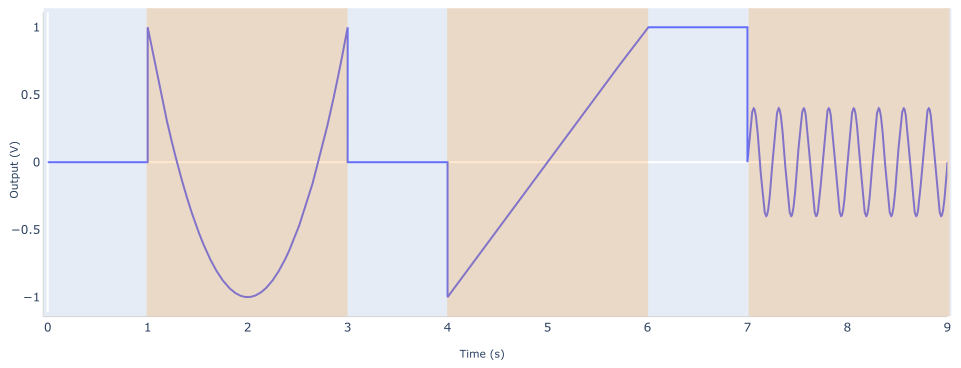
ao_chan.add_instr(
    t=1, dur=2, keep_val=False,
    func=std_fn_lib.Poly([7, -8, 2])
)
ao_chan.add_instr(
    t=4, dur=2, keep_val=True,
    func=std_fn_lib.LinFn(slope=1, offs=-5)
)

# Unspecified duration
ao_chan.add_gothis_instr(
    t=7,
    func=std_fn_lib.Sine(amp=0.4, freq=4)
)

ni_strmr.compile(stop_time=9);
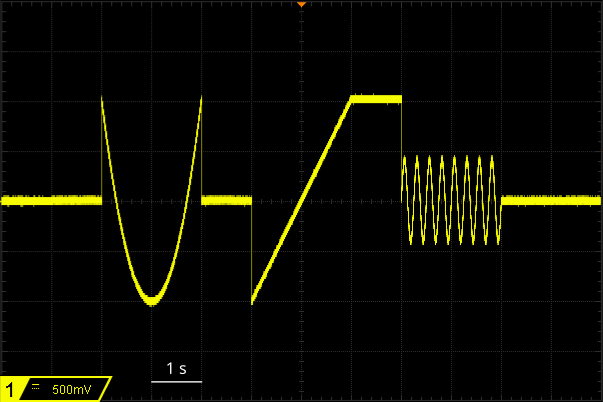
ni_strmr.run()
Note
If the built-in library does not contain the waveform you need, custom ones can be added through the user function library (see the tutorial).