Project Structure#
In essence, nistreamer package is an abstraction layer on top of the proprietary NI driver. It interacts with the driver via NI-DAQmx C API.
The package itself consists of two layers - the Rust back-end and the Python front-end. Most of the logic is actually contained in the back-end, while the front-end is a very thin layer providing a user-friendly Python API (see details below).
Rust Back-end#
The back-end is split into several packages. The dependency graph is shown below.
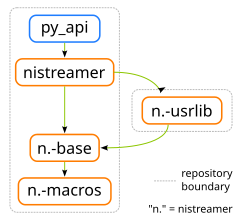
(1) nistreamer-base contains base traits:
Waveform function library base:
Traits
Calc<T>andFnTraitSet<T>- the definition of a waveform function;FnBoxtypes for passing waveform objects across Python;A built-in “standard library” of waveform functions.
Base traits for all hardware elements:
Channels (instruction collision checks, sequence compilation, and sample computation logic);
Devices (mainly common timing across all channels);
Streamer (mainly common timing across all devices).
(2) nistreamer contains specific types and all hardware configuration details:
A Rust wrapper of NI-DAQmx C API (
nidaqmx.rsmodule);Concrete structs for the streamer, AO and DO channels and cards;
Multi-threading implementation;
The Rust-Python interface layer (flattened Rust API, PyO3 wrapper, see details below).
Together, nistreamer-base and nistreamer contain the bulk of the back-end logic. In addition, there are two smaller crates:
(3) nistreamer-macros contains helper procedural macros for waveform function libraries.
(4) nistreamer-usrlib is an optional dependency and provides a space for a user-editable custom waveform library. It is also split out into a separate GitHub repository such that users can create and maintain their own fork.
The schematic below is showing how logic is distributed between the crates:
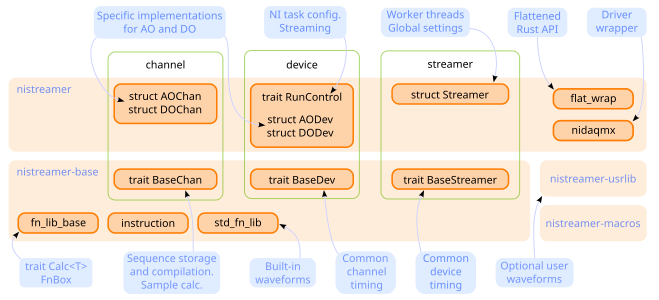
Crate nistreamer is the head of the dependency chain - building it will trigger compilation of all other ones and will build the whole package. nistreamer_usrlib is optional and is only included when building with --features usrlib flag.
There are several reasons for such sub-package structure. First, nistreamer-macros has to be separate since it is a procedural macro crate. Second, nistreamer-usrlib should be outside the main codebase since it is optional and moreover a user-editable part. Finally, there are two reason for splitting the core logic into nistreamer-base and nistreamer:
To avoid the cyclic dependency issue when including
nistreamer-usrlib.
nistreamer-usrlibdepends on waveform traits fromnistreamer-base, whilenistreamerdepends onnistreamer-usrlibto include user library class into the final extension module inlib.rs. If the two core packages were a single crate, there would be a cyclic dependency.Such separation simplifies development. If any changes are made to
nistreamer-base, one can attempt compiling it without having to refactornistreameryet.
Rust-Python Interface#
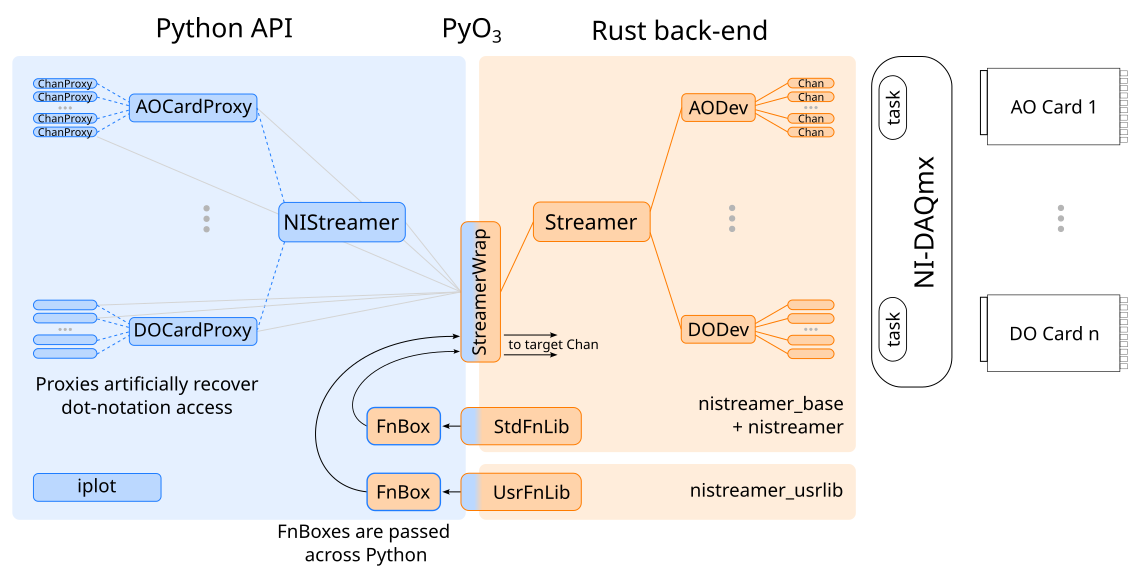
We use a combination of PyO3 and maturin to build and wrap the back-end as a Python extension module.
To expose public methods of a streamer and all contained devices and channels, we bring them together in a “flattened” manner as methods of a single StreamerWrap struct which is annotated as #[pyclass] (see flat_wrap.rs module). So in Python, there is only a single “monolithic” entity representing the entire streamer tree - a StreamerWrap instance. Calling a method on a particular channel, for example, is done through a corresponding method of StreamerWrap by providing the full device and channel identifiers.
This approach minimizes the Rust-Python boundary at the cost of losing the user-friendly dot notation access to device and channel methods. It is artificially restored by the Python front-end layer (see next section).
When building with maturin, compiled backend is packaged as an importable DLL module _nistreamer.pyd which is placed directly into the front-end directory for use by the proxy classes.
Apart from StreamerWrap, there are two more #[pyclass]es which go into _nistreamer.pyd - the built-in StdFnLib and the optional UsrFnLib waveform libraries which will be described in detail in a separate section.
Python Front-end#
The user-facing Python front-end is contained in py_api directory. It is a very thin layer on top of StreamerWrap with the main function to artificially restore the dot notation access to device and channel methods which was lost when going through the interface (see previous section).
Every device and channel is represented by a corresponding proxy instance, which stores a direct reference to the central StreamerWrap as well as the device/channel identifiers. The user script is making dot-notation proxy method calls, while proxies in turn are simply calling the corresponding methods of StreamerWrap with their device/channel identifiers as arguments.